Pandora, the virtual planet that reveals the links between tectonics and climate
- Research
on the November 3, 2026
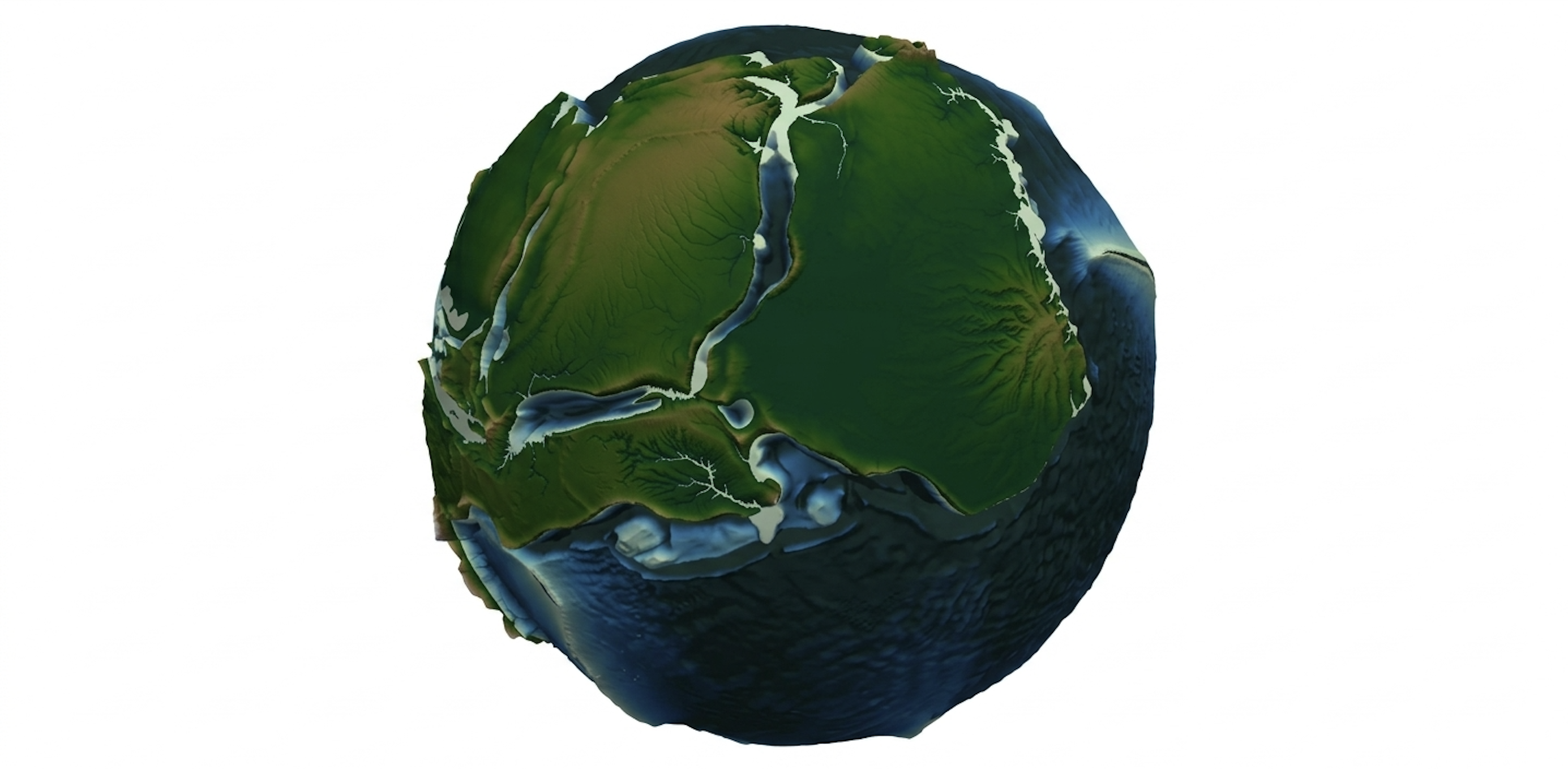
An international team coordinated by Université Côte d’Azur, involving scientists from the CNRS and Lyon 1 University, has developed a groundbreaking numerical simulation that reproduces the evolution of a planet, from its deep mantle to its surface. Named Pandora, it enables researchers to study how the Earth’s internal movements influence plate tectonics, landscapes, and climate change on a geological timescale.
This simulation represents a major breakthrough: it integrates, within a single calculation, the dynamics of the Earth’s mantle, continental drift, climate, erosion, and sediment transport. Until now, models have been unable to represent these phenomena so comprehensively, while geological records—which are inherently fragmentary—preserve only part of our planet’s history.
The Formation of Supercontinents Can Cool the Planet
The simulations highlight the role of the planet’s internal movements in climate variations. When a supercontinent forms, tectonic movements can drive it toward the equator, causing sea levels to drop. The expansion of landmass into tropical regions then promotes the reflection of solar radiation and rock weathering, a process that consumes atmospheric carbon dioxide (CO₂). These mechanisms contribute to the planet’s cooling.Conversely, when the supercontinent breaks apart, the renewal of the ocean floor is accompanied by a rise in sea level that can reach up to 100 meters in the simulation. The continents become more inundated, and volcanic outgassing increases, contributing to a rise in atmospheric CO₂ and global warming.
These alternating cold and warm phases emerge from the dynamics of the simulated system, without the need to introduce any external perturbation such as a variation in solar activity or an asteroid impact. They bear similarities to certain episodes in Earth’s climate history, particularly following the breakup of Pangaea.
By bringing together processes that are usually studied separately, Pandora opens up new perspectives for understanding the relationships between a planet’s interior, its surface, and its climate. This approach allows us to explore how geological dynamics can help shape environments over millions of years.
Beyond reconstructing Earth’s history, this research could contribute to a better understanding of the evolution of other rocky planets and the conditions that promote their habitability.
- Researcher Contact
-
Nicolas Coltice | nicolas.coltice@oca.eu
- References
-
https://escholarship.org/uc/item/2j625548
Coltice, N.; ARNOULD, M.; Husson, L.; Leonard, J.; Martin, M.; Pellissier, L., et al. (2026). Mantle-Driven Environmental States during Supercontinent Assembly and Breakup. Geodynamica, 1(1). http://dx.doi.org/10.5070/F3.62175