Université Côte d’Azur – Laval University: A Historic Partnership Looking Toward the Future
- International
- IDEX
- Research
- Award
Published on May 18, 2026
–
Updated on May 18, 2026
Dates
on the April 28, 2026
The week of April 20, 2026, dedicated to the 10th anniversary of the partnership and the presentation of the strategic plan, marked an important milestone in the unique partnership between Université Côte d’Azur and Université Laval.
In particular, the day of Thursday, April 23 provided an opportunity to reflect on the wealth of work accomplished over the past decade and to explore new avenues for collaboration, pointing to a promising and highly stimulating future for the partnership.
Three highlights marked the event.
A member of the French Academy of Sciences and the Academia Europaea, and recipient of the CNRS Gold Medal, Michel Lazdunski is recognized as a pioneer of modern pharmacology . By shedding light on the mechanisms underlying complex phenomena such as pain, epilepsy, depression, certain cardiovascular diseases, and cystic fibrosis, his work paved the way for new therapeutic strategies.
He has also founded and directed several major CNRS research centers, notably in Nice and Sophia Antipolis, helping to create scientific environments of exceptional vitality.
Michel Lazdunski is not only a pioneer. He is also a builder, emphasizes Sophie D’Amours, Rector of Laval University.
The international associated laboratory SYstèmes Neuroendocriniens : Adaptation, Plasticité, Signalisation et Environnement (SYNAPSE), the result of a long-standing collaboration between the IPMC (Université Côte d’Azur, CNRS, and Inserm) and the Faculty of Pharmacy at Laval University, is dedicated to studying brain-body interactions in response to the growing global challenges of metabolic and mental diseases. It specifically addresses the following issues:
These various initiatives, which serve as powerful drivers of impact, reflect the shared vision of both universities: to make this partnership a laboratory for academic innovation, driven by its communities, with the ambition of strengthening our collective capacity to act in favor of a more sustainable future .
Three highlights marked the event.
Prof. Michel Lazdunski Honored by Laval University
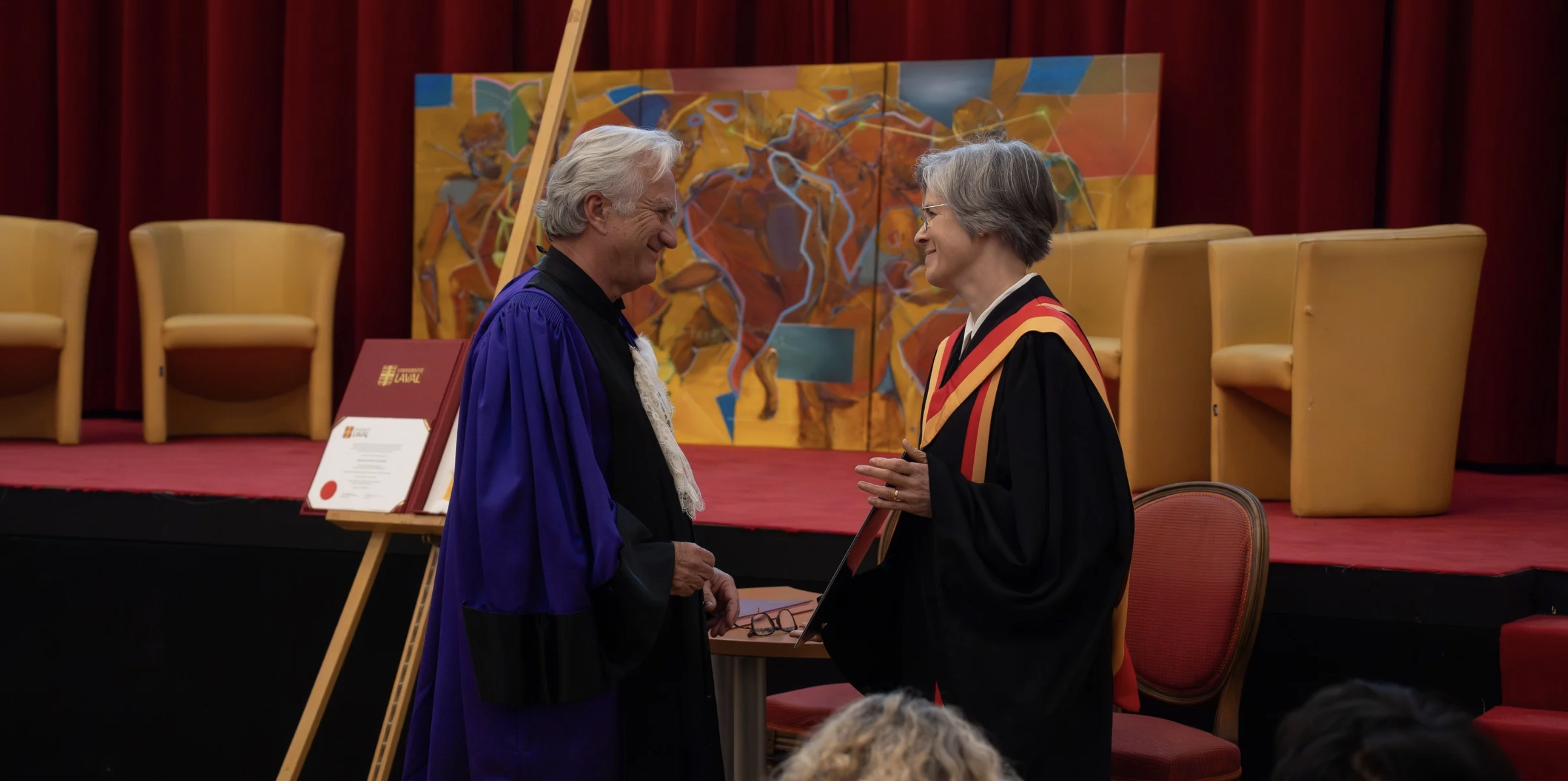
Laval University awarded an honorary doctorate to Professor Michel Lazdunski, a powerful symbol of the bond between the two institutions and the scientific legacy they share. Trained at Laval University, where he earned a Ph.D. in physical chemistry in 1962, Professor Michel Lazdunski went on to lead a remarkable scientific career spanning more than half a century.A member of the French Academy of Sciences and the Academia Europaea, and recipient of the CNRS Gold Medal, Michel Lazdunski is recognized as a pioneer of modern pharmacology . By shedding light on the mechanisms underlying complex phenomena such as pain, epilepsy, depression, certain cardiovascular diseases, and cystic fibrosis, his work paved the way for new therapeutic strategies.
He has also founded and directed several major CNRS research centers, notably in Nice and Sophia Antipolis, helping to create scientific environments of exceptional vitality.
Michel Lazdunski is not only a pioneer. He is also a builder, emphasizes Sophie D’Amours, Rector of Laval University.
The creation of the SYNAPSE laboratory
The international associated laboratory SYstèmes Neuroendocriniens : Adaptation, Plasticité, Signalisation et Environnement (SYNAPSE), the result of a long-standing collaboration between the IPMC (Université Côte d’Azur, CNRS, and Inserm) and the Faculty of Pharmacy at Laval University, is dedicated to studying brain-body interactions in response to the growing global challenges of metabolic and mental diseases. It specifically addresses the following issues:
- The prevention of chronic societal diseases linked to lifestyle and the environment;
- Reducing health inequalities by understanding the biological and social determinants of metabolism and behavior;
- The transition to precision medicine focused on biological signatures;
- Adapting healthcare systems to the increasing prevalence of metabolic, cognitive, and affective disorders.
Partnership Renewed for Five Years
The renewal of the partnership is accompanied by a strategic plan structured around high-impact thematic areas:- Health and aging;
- Artificial Intelligence and Robotics;
- Environment and territory;
- Arts and Cultural and Creative Industries;
- Human Security.
These various initiatives, which serve as powerful drivers of impact, reflect the shared vision of both universities: to make this partnership a laboratory for academic innovation, driven by its communities, with the ambition of strengthening our collective capacity to act in favor of a more sustainable future .
/ 1