
Published on July 31, 2026
–
Updated on July 31, 2026
Dates
on the July 22, 2026
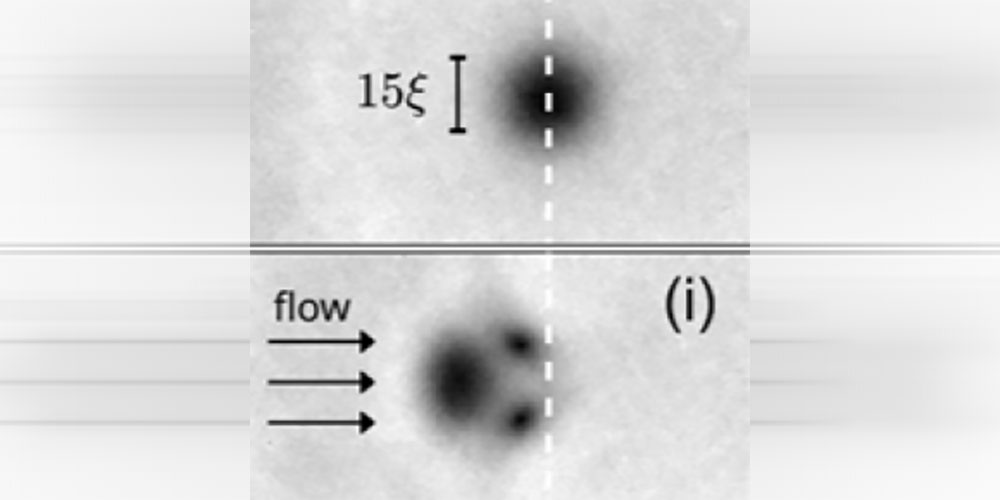
A research team from the Nice Institute of Physics, in collaboration with the Kastler-Brossel Laboratory and the Laboratory of Theoretical Physics and Statistical Models, has uncovered a previously unknown phenomenon: a “quantum fish” capable of swimming upstream against a superfluid current. This discovery paves the way for a new form of propulsion in quantum fluids.
How can an object move without a motor in a fluid where the classical laws of physics no longer apply entirely? This is the question researchers are exploring through their study of this “quantum fish,” a microscopic device immersed in a superfluid.
Their work reveals a new form of propulsion linked to the unique properties of quantum fluids and sheds new light on the interactions between microscopic objects and the quantum states of matter.
This research was published in June 2026 in *Physical Review Letters *.
Read the full article on the CNRS Biology website.
Their work reveals a new form of propulsion linked to the unique properties of quantum fluids and sheds new light on the interactions between microscopic objects and the quantum states of matter.
This research was published in June 2026 in *Physical Review Letters *.
Read the full article on the CNRS Biology website.