
For a long time, video games were viewed with suspicion. When they first arrived in Western homes in the 1970s and 1980s, they were seen as a silent intruder, largely escaping the attention of adults. The first home consoles—fromthe Atari 2600 to Nintendo —introduced a predominantly solitary, absorbing activity that was perceived as cutting players off from the social world.
Very quickly, video games became the focus of moral panic comparable to that previously directed at rock music, comic books, and television.
In the 1990s, the fear changed tone. With the media coverage of so-called "violent" games—from Doom to Grand Theft Auto —video games were regularly singled out in discussions about juvenile delinquency. Controversies surrounding violence, addiction, and social isolation multiplied, fueled by often contradictory scientific studies.
Video games: a source of educational tension or dialogue
However, a first shift took place at the turn of the 2000s. The rise of network gaming, then massively multiplayer online gaming (World of Warcraft, Counter Strike), shifted the issue: people were no longer playing alone, but with other players who could be nearby (on a LAN) or on the other side of the world. Video games became a space for socializing, cooperation, and regulated competition.
At the same time, Nintendo's Wii, followed by so-called casual games, physically entered the living room and reconfigured family habits, transcending generational boundaries.
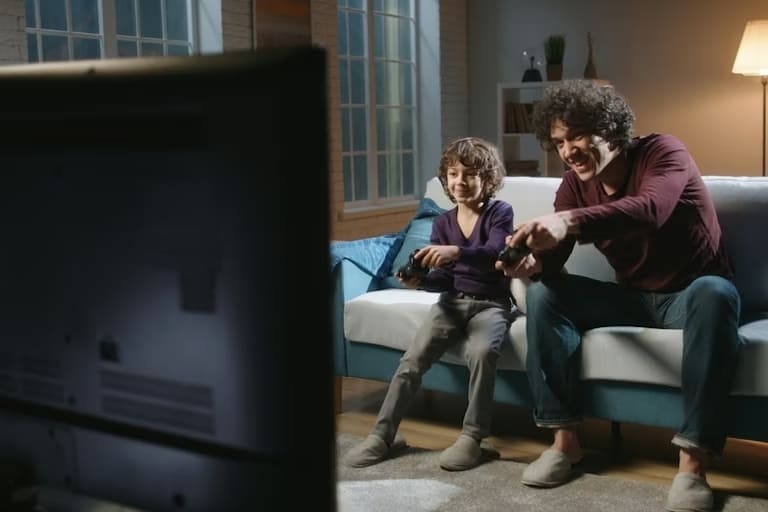
Today, the status of video games has been reversed. Parents and children play together, discussing the worlds, rules, and emotions they experience. Independent games—such as That Dragon, Cancer and Celeste—address existential, political, or intimate themes, while mainstream titles such as Minecraft and Animal Crossing become shared testing grounds. This is especially true since video gaming is mainly done at home (86%), as indicated by the Ludespace survey used in the book La Fin du game ? Les jeux vidéo au quotidien (2021).
This reversal does not erase tensions. Video games remain a source of educational tension, with issues around screen time, regulation, and parental control. But they are now also a mediating object, used to negotiate rules, transmit values, and build shared narratives. From a despised object to a meeting place, video games thus reflect the evolution of family ties in the digital age.
Passing on a playful heritage
The latest annual survey by the Syndicat des éditeurs de logiciels de loisirs (SELL) indicates that more than 7 out of 10 French people regularly play video games. The parents of today's children and teenagers are in the 35-50 age group. This means that they themselves were children or teenagers between 1985 and 2005 and are therefore potentially holders of a video game culture, from the first consoles for the older ones to the 3D games of the 2000s. They also experienced the phenomenon of "portable gaming" with the Game Boy and its successors (1989-2003), the Nintendo DS (2004) and even the PSP (2007).
Culturally, for this generation, video games are not a new practice, and they are not limited to childhood or adolescence, as 75% of these parents continue to play. They have also been immersed in the globalized culture of the media and are familiar with its icons, which have been an integral part of their lives since childhood.
From this point of view, passing on the gaming heritage to the next generation within the family is crucial, and this is evident in public surveys: interest in a franchise, which implies cultural continuity, motivates almost a third of purchases. Furthermore, whether playing online or locally, more than half of gamers across all generations (around 55%) say they play with others, and 88% say that video games are a leisure activity for the whole family.
The place of "machines" in the family space
The question also concerns what is being passed on. Is it characters, gameplay (ways of playing) or universes, as promoted by publishers, or is there something else, less visible or beyond the scope of marketing discourse and audience studies?
The constitution of the family as such has changed. Whereas families used to have children, today it is children who make families. This has changed the way traditions are passed on and families are formed. This individualistic model is now reflected in the number of screens in households. The television set, which could only show one program or game at a time, has given way to nearly six screens per household in 2024.
This proliferation can hinder intra-family exchanges, with everyone sitting in front of their own screen, "alone together. " However, broadcasters are responding to consumer demand for sharing with the "family viewing" category that appears on platforms, or asynchronous sharing, where everyone watches the same program.
Parents are not helped by the paradoxical injunctions of the education and health sectors, finding themselves, as journalist François Saltiel and researcher Virginie Sassoon have pointed out, alternately acting as police officers and screen dealers.
While video games have not relieved parents and families of the human problem of transmission, what is now a fact is the presence of the machine in homes. This discreet presence, covered by the "eye-catching" screen, is nevertheless constant. Playing a video game always means playing with (or against) the machine. What is transmitted within the family through video games is also familiarity with the machine.
A culture in perpetual reinvention
Psychiatrist Ernst Jentsch uncovered this Unheimliche, this uncanny familiarity that Sigmund Freud's essay popularized. This concept is based on the fact that the most familiar objects and places can appear, often transiently and briefly, to be completely unsettling.
Freud gives the example of moments when we do not immediately recognize our own reflection in a mirror. Machines allow us to renew these experiences of uncanny familiarity, as illustrated by robotics engineer Masahiro Mori's "uncanny valley" theory, which refers to the moment when robots, resembling both "too much" and "not enough" a real human being, become disturbing.
Perhaps video games, supported by the machine (the hardware), replay this dual and simultaneous Unheimliche nature of the machine, which is both familiar and disturbing.
Without claiming to provide parents with a ready-made guide, we can think, in line with what Hannah Arendt proposed, that transmission takes place on the condition that sustained attention is paid to the way in which the recipient reinvents what is passed on to them.
Beyond the franchises renewed generation after generation by commercial firms, the success of "retrogaming" and the various emulators that allow users to replay old games seem to show that video games are no exception to this logic. However, they will probably not dispel the disturbing familiarity of what is being passed on: Restart and play again!
Quentin Dumoulin, MCU - psychology, clinical psychopathology, researcher at LIRCES (Université Côte d'Azur) and Marc Marti, University Professor, specialist in narratology and video games, researcher at LIRCES (Université Côte d'Azur)
This article is republished from The Conversation under a Creative Commons license. Readthe original article.
THE CONVERSATION
Université Côte d’Azur, through its Science and Society department, has been a member of the online news media outlet "The Conversation" since January 2022. The aim is to highlight the work of our research teams in the service of informed and reliable information that contributes to public debate.
The Conversation is an online media outlet and a non-profit association. Its model of collaboration between experts and journalists is unique: sharing knowledge, giving researchers a voice in public debate, and informing the news with reliable, research-based expertise.
theconversation.com
SUBSCRIBE!
To follow The Conversation's experts on a daily basis, subscribe to the newsletter.
theconversation.com/en/new