Plant-based epoxy resins that are recyclable and self-healing thanks to a natural compound
Research
Published on March 16, 2026–Updated on March 16, 2026
Dates
on the February 16, 2026
ICN
In a study published in the journal ACS Sustainable Chemistry and Engineering in February 2026, Alice Mija, Sandra Olivero, and Véronique Michelet of the Nice Institute of Chemistry developed new, fully bio-based epoxy polymers derived from carvone, a natural compound found in plants and present, in particular, in certain essential oils.
In addition to these studies on the utilization of carvone, Alice Mija’s group at the Institute of Chemistry in Nice (Université Côte d’Azur, CNRS) has been researching and developing high-performance, recyclable bio-based epoxy resins for many years.
Conventional
epoxy resins are ubiquitous in our daily lives, particularly in composite materials, adhesives, and coatings. Derived primarily from petroleum resources, they nevertheless have major limitations: potential toxicity, inability to be recycled, and a high environmental impact.
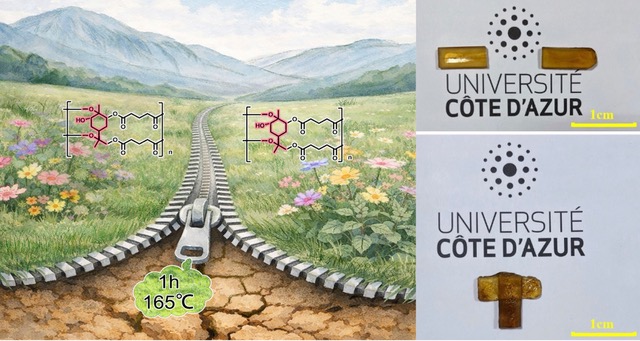
Using carvone derivatives, the scientists synthesized several bio-based epoxy resins, then processed them to obtain four distinct materials, all derived entirely from renewable resources. Extensive mechanical testing identified a particularly high-performance material: the one containing hydroxyl groups—specific chemical functions—gives the resin an excellent combination of stiffness, strength, and durability. The innovative materials thus obtained combine high mechanical performance, recyclability, and self-healing capabilities, opening new avenues for more sustainable materials.
Notably, this material also exhibits biomimetic properties: it is capable of self-healing its cracks without the addition of external substances. A rare characteristic that could significantly extend the lifespan of materials and reduce their environmental impact.
This research demonstrates the potential of carvone and, more broadly, plant-derived terpenes for designing renewable, recyclable, and self-healing epoxy resins. It thus paves the way for credible and sustainable alternatives to conventional polymers, with potential applications across numerous industrial sectors.