Excerpt 1
For the past few months, I have been going through a staggering, heart-wrenching experience. It is neither romantic nor friendly… I feel things breaking, bleeding profusely, screaming inside me, yet it is not a physical experience. Don’t expect a detective novel or a fairy tale: I’ve opened the pages of my lost research. Without having found it. I’ve never found it.
I’m talking about my sociological research on the Kurdish movement. The research that was taken from me, that was torn from me, and that has disappeared. I discovered the most tragic part of this story: its erasure from my memory. To this day, I tell the media that in July 1998, my research materials became the subject of a political offense: for allegedly harming the nation, they were confiscated by the Turkish police.
It all began in 1995. I was 24 years old and living in Istanbul, in a country torn apart by a conflict that no one could name. Since 1984, a war had been raging between the Turkish state and the Kurdish movement. This movement championed the demands of a people whose language had been banned, whose history had been denied, and whose very existence was contested by the Turkish nationalist and militarist regime.
Estimated at over 45 million people, this population was divided by the national borders of Turkey, Iran, Iraq, and Syria. This war was accompanied by an unprecedented popular mobilization: despite the 35,000 political prisoners, systematic torture, and daily disappearances, more and more young Kurds were joining the resistance, and the funerals of guerrilla fighters were turning into uprisings. But it was forbidden to speak of it. One had to use the words imposed by the authorities: enemies, terrorists, devils. Speaking of a social conflict—or even of a conflict at all—was a dangerous act.
The political establishment, by marginalizing critical thought, fostering contempt for theory, and trivializing the irrational and the absurd, governed people’s emotions. All of this was very frightening. Yet it was a responsibility to demonstrate that things were more complicated than assumed and that the reductive formulations summarizing reality were blinding. And to demonstrate this, one first had to investigate. I did so. I refused to bow down to this madness. I reflected, I asked questions.
Thus, a research-responsibility project took shape, leading me to examine a banned social movement, driven by a marginalized and criminalized population, within a context of war.
On July 11, 1998, I was arrested by the Istanbul police. They confiscated all my materials related to this work—notebooks, floppy disks… They demanded that I hand over the names of my informants. I was subjected to torture that for a long time prevented me from engaging in any physical or intellectual activity.
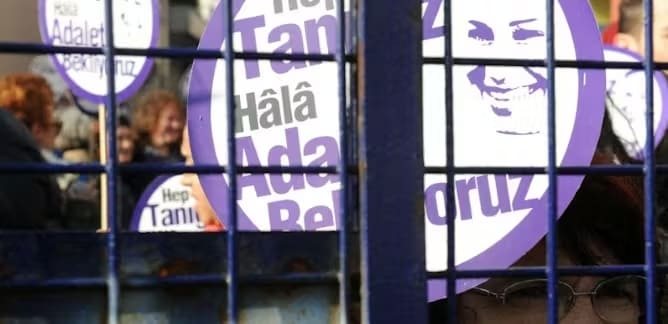
Despite the severity of my ordeal, I managed to protect their safety without ever revealing any information and by adhering to ethical standards, such as attorney-client privilege. In the face of my resistance, the grip of horror tightened: one month after my arrest, while I was in prison, I learned on television that the Turkish authorities had decided to label me a terrorist by falsely accusing me of being involved in the attack at the spice bazaar in Istanbul, even though it had been established that the explosion was an accident. After two and a half years in prison and four acquittals in 2006, 2008, 2011, and 2014, I am still, to this day, subjected to political and judicial harassment: the trial has been going on for 27 years.
Excerpt 2
I opened the pages of my lost research. Without having found it. I never found it. I am talking about my sociological research on the Kurdish movement. The research that was taken from me, that was snatched away, and that has disappeared. I discovered the most tragic aspect of this story: its erasure from my memory.
To this day, I tell the media that in July 1998, my research materials became the subject of a political offense: for allegedly harming the nation, they were confiscated by the Turkish police. […]
I had all the necessary means to resume my unfinished investigation. […] But until then, I hadn’t thought about it for a single moment. It was as if it were finished. No, it was taken from me. And I should just abandon it? How can a project I began with great curiosity and pursued with enthusiasm right up to the last minute remain unfinished? Why didn’t I at least write down everything I had learned?
My research was truly interrupted. What’s strange is that I didn’t even think of this work as unfinished. Had I internalized the prohibition on my materials? Is this my point of non-resistance? If so, how do I explain that I often speak out on this issue in public? It doesn’t seem to be fear. What else? Fatigue? Unlikely. My post-traumatic stress disorder? A mental block?
If not, what?
I’ve been thinking. My research is a living organism. It was born and has continued to grow. It was taken away, not aborted. The birth of a research project is not its publication. Its materials are wounded but still alive, in transformation, in vibration. To heal them, I write.
Why now? How is it that I suddenly realized this, after 27 years? Realizing my wounded research within me. Since nothing falls from the sky, how did this revelation come about?
I am truly astonished. Deeply astonished. And it is this deep astonishment that gives me the strength to write. I write to discover and to rid myself of the turmoil.
I will discover myself through writing. I will write it, you will read it. We will discover it together.
Pinar Selek, Associate Professor of Sociology, researcher at the URMIS laboratory (Université Côte d’Azur, CNRS, IRD, Université Paris Cité)
This article is republished from The Conversation under a Creative Commons license. Read the original article.
THE CONVERSATION
Université Côte d'Azur, through its Science and Society department, joined the online news outlet "The Conversation" in January 2022. The goal is to highlight the work of our research teams in providing accurate and reliable information that contributes to public discourse.
The Conversation is an online media outlet and a non-profit organization. Its model of collaboration between experts and journalists is unique: sharing knowledge, giving researchers a voice in public debate, and shedding light on current events through reliable, research-based expertise.
theconversation.com
SUBSCRIBE!
To follow The Conversation’s experts daily, sign up for the newsletter.
theconversation.com/fr/new