Published on May 13, 2026
–
Updated on May 13, 2026
Dates
on the May 6, 2026

Université Côte d’Azur at the heart of European research: the TASTADE project has received a €10 million ERC Synergy Grant.
As part of the prestigious Horizon Europe program, the European Research Council (ERC) has selected the TASTADE project, led in particular by Université Côte d’Azur. This ambitious project aims to reassess the historical impact of the transatlantic slave trade on Europe’s development.
The ERC Synergy 2025 program is one of the most competitive funding initiatives in the European Union, designed to support cutting-edge research projects capable of pushing the boundaries of knowledge. This year, only 66 projects were selected from over 700 proposals.
Among the winners is TASTADE (The Trans-Atlantic Slave Trade and the Development of Europe), which directly involves Université Côte d’Azur through the participation of Professor Silvia Marzagalli, a faculty member in the Department of History and at EUR Society & Environment, a researcher at the CMMC laboratory , and co-coordinator of the project, who contributes her expertise in the French slave trade of the modern era and her skills in Digital Humanities and the visualization of uncertain data (ANR Portic program ).
The TASTADE project tackles a fundamental question: how did investors in the transatlantic slave trade shape European economies, politics, and cultures?
While traditional historiography has often considered the impact of this trade to be marginal for Europe, TASTADE proposes a paradigm shift.
Key research objectives include:
TASTADE’s success is built on high-level international collaboration. Led by Lancaster University (United Kingdom), the project brings together four coordinators from four key institutions:
With a total grant of 9,999,324 euros, TASTADE has exceptional resources to carry out its archival work across numerous languages and national contexts. This project perfectly illustrates the European Research Council’s ambition to support “borderless” science to address the most complex societal challenges.
For the EUR Society & Environment, this distinction confirms Université Côte d’Azur’s position as a leader in the global landscape of research in the humanities and social sciences.
Congratulations to our colleague Silvia Marzagalli on this well-deserved recognition!
Stay tuned for more information on the TASTADE project...
A major success for Université Côte d’Azur
The ERC Synergy 2025 program is one of the most competitive funding initiatives in the European Union, designed to support cutting-edge research projects capable of pushing the boundaries of knowledge. This year, only 66 projects were selected from over 700 proposals.
Among the winners is TASTADE (The Trans-Atlantic Slave Trade and the Development of Europe), which directly involves Université Côte d’Azur through the participation of Professor Silvia Marzagalli, a faculty member in the Department of History and at EUR Society & Environment, a researcher at the CMMC laboratory , and co-coordinator of the project, who contributes her expertise in the French slave trade of the modern era and her skills in Digital Humanities and the visualization of uncertain data (ANR Portic program ).
TASTADE: Rethinking the History of Europe
The TASTADE project tackles a fundamental question: how did investors in the transatlantic slave trade shape European economies, politics, and cultures?
While traditional historiography has often considered the impact of this trade to be marginal for Europe, TASTADE proposes a paradigm shift.
Key research objectives include:
- The identification of tens of thousands of investors: Beyond large companies, the project studies the men and women who financed these expeditions and their political, commercial, and cultural networks (religious affiliation, philanthropy, etc.).
- A transnational approach: By breaking down the “silos” of national research and the imperial logic of the time, the team analyzes the networks that connected investors across Europe and its colonies, highlighting the transnational connections among investors.
- A multidimensional analysis: The project is not limited to studying the financial profits of the slave trade but also explores the profound political and cultural transformations brought about by this system.
Global scientific synergy
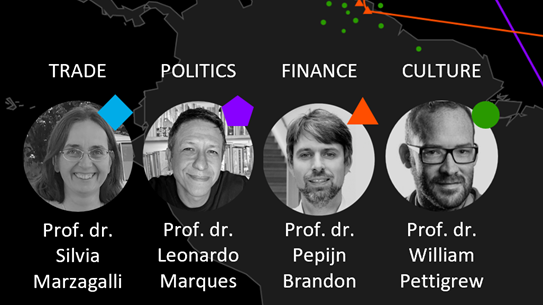
TASTADE’s success is built on high-level international collaboration. Led by Lancaster University (United Kingdom), the project brings together four coordinators from four key institutions:
- Prof. Silvia Marzagalli of Université Côte d’Azur (France)
- Prof. William Pettigrew of Lancaster University (United Kingdom)
- Prof. Pepijn Brandon of Vrije Universiteit Amsterdam (Netherlands)
- Prof. Leonardo Marques from Universidade Federal Fluminense (Brazil)
Funding commensurate with the challenges
With a total grant of 9,999,324 euros, TASTADE has exceptional resources to carry out its archival work across numerous languages and national contexts. This project perfectly illustrates the European Research Council’s ambition to support “borderless” science to address the most complex societal challenges.
For the EUR Society & Environment, this distinction confirms Université Côte d’Azur’s position as a leader in the global landscape of research in the humanities and social sciences.
Congratulations to our colleague Silvia Marzagalli on this well-deserved recognition!
Stay tuned for more information on the TASTADE project...