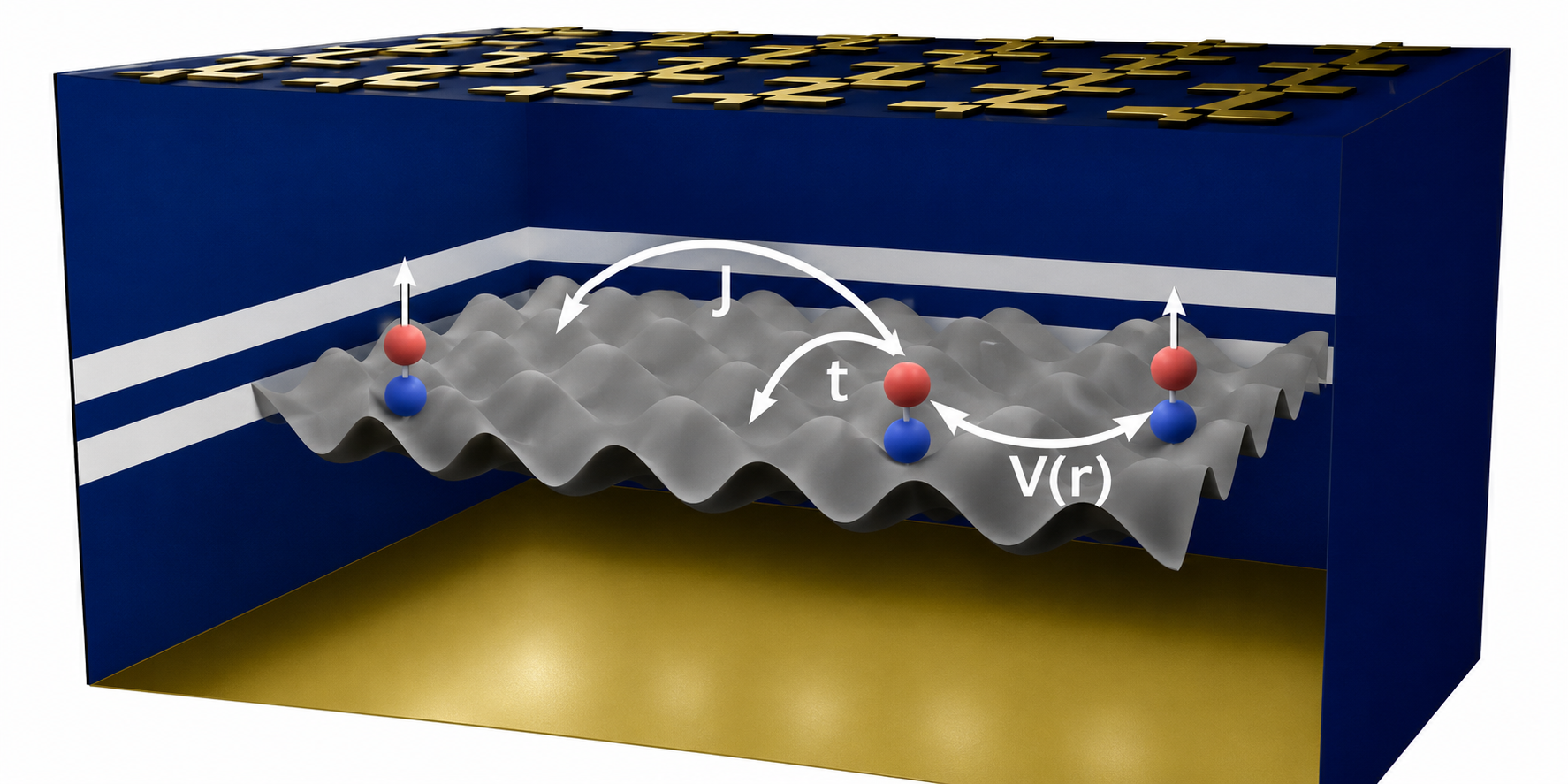
François Dubin’s team at the Research Center for Heteroepitaxy and Its Applications has uncovered a previously unobserved phenomenon: excitons capable of forming collective phases without dissipation and with long-range interactions. Published in *Nature Physics* in [year], this research opens up new avenues for simulating complex quantum systems.
By optically exciting a semiconductor, an electron can be promoted from a low-energy state—known as the valence band—to a conduction band state (a free, delocalized electron). The vacancy left in the valence band remains correlated with the free electron, leading to a bound state—specifically, a bosonic quasiparticle known as an exciton. Until now, excitons have primarily been studied in the context of a semiconductor’s electronic polarization, which is controlled by Coulombic collisions between excitons.
By exploring the situation where the exciton fluid is highly diluted, so that collisions become rare, physicists have succeeded in manipulating the optical polarization that characterizes the excitonic wave functions. These are indeed affected by coupling with photons, which can induce successive emissions and absorptions of virtual photons. These lead to spatial delocalization that introduces long-range correlations. A quantum solid with collectively induced phase coherence was thus observed for the first time.